
Key insights
- Geopolitical tensions between the US and Iran are creating uncertainty, though investors are hoping for a de-escalation. This, combined with upcoming US inflation data, is leading to cautious trading. While consumer discretionary stocks saw gains on decent earnings, energy and some tech names faced pressure. Canadian bank earnings were mixed but generally positive. The market is awaiting clearer signals on inflation and geopolitical outcomes.
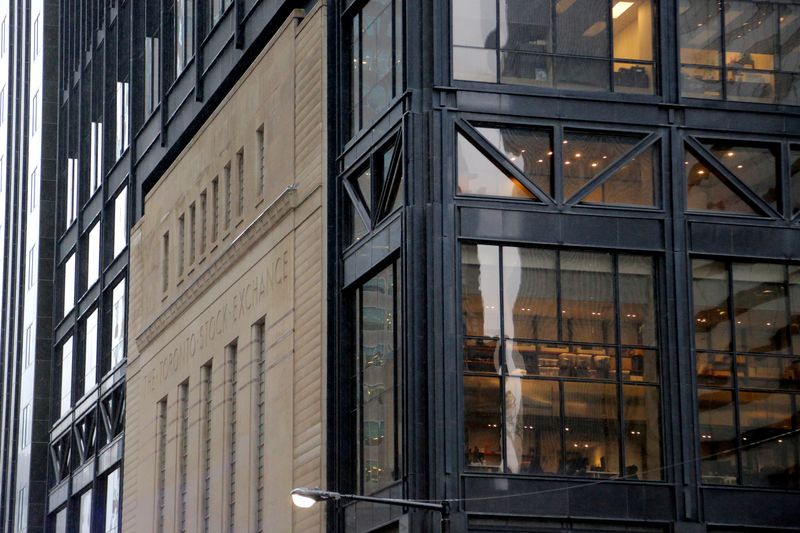
Investing.com - Canada’s main stock index is trading slightly higher Thursday, as investors gauged a fresh exchange of strikes between the U.S. and Iran which dented hopes for an imminent peace deal.
By 12:14 ET (16:14 GMT), the S&P/TSX 60 index had risen by 0.5 points, or 0.03%. The S&P TSX index is up 105 points or 0.3%.
Results from major Canadian banks this week were also in focus. Royal Bank of Canada, the country’s biggest lender, posted an increase in second-quarter profit thanks to market volatility that bolstered its trading business.
TD Bank posted elevated interest income, which led to a jump in adjusted income for the second quarter.
U.S. stocks are trading higher. The main averages on Wall Street ended the previous day modestly higher, with analysts at Vital Knowledge suggesting that hopes remain that an agreement to end the war in Iran will be struck in the coming days. Still, some optimism was tempered by the White House’s declaration that a Memorandum of Understanding draft published by Iranian state TV was a "complete fabrication."
A decline in Brent crude futures, the global oil benchmark, combined with "decent" earnings reports, particularly from Abercrombie & Fitch and Bath & Body Works, and "sanguine" economic commentary from companies at a closely-watched conference to help "catalyze big gains in consumer discretionary stocks," the Vital Knowledge analysts said.
Energy-linked names, however, were under some pressure, while investors booked profits on some recently red-hot tech names, they added.
"Investors are biding their time regarding the Middle East and, despite the resurgence of attacks, continue to hope for a constructive outcome to negotiations between the U.S. and Iran. However, this is causing trading volume to thin out and price volatility to decline," said Andreas Lipkow, Chief Market Analyst at CMC Markets.
The U.S. military struck targets near the Iranian city of Bandar Abbas earlier in the day, drawing retaliatory measures from Iran’s Islamic Revolutionary Guard Corp (IRGC), media reports said.
The IRGC said it had struck a U.S. military base in Kuwait as retaliation for the Bandar Abbas attacks. Separately, Kuwaiti authorities said they defending against drone and missile attacks.
Reuters reported that the U.S. military shot down four Iranian attack drones and hit a ground control station in Bandar Abbas.
The attacks marked a potential resumption in open hostilities between the U.S. and Iran, especially after Tehran warned of retaliation following U.S. strikes earlier this week.
The U.S. military claimed that the attacks were in "self defense," and that a ceasefire with Iran remained.
Thursday’s attacks came shortly after U.S. President Donald Trump dismissed a report that Iran and Oman will manage shipping through the Strait of Hormuz under a deal to end the war. Trump also indicated that Iran wanted to make a deal, but that he was not satisfied with the agreement yet.
Oil prices climbed, maintaining concerns over a wave of energy-induced inflation that could persuade central banks around the world to raise interest rates.
A gauge of inflation closely watched by the Federal Reserve rose as expected in April on an annualized basis, and decelerated marginally month-on-month, as investors kept tabs on the impact of the Iran war on prices and interest rates.
The so-called "core" personal consumption expenditures price index, which strips out volatile items like food and fuel, came in at 3.3% in April, in line with expectations and above March’s reading of 3.2%.
Month-on-month, the reading stood at 0.2%, down from estimates that it would equal 0.3% in March.
Headline PCE was 3.8% year-on-year, also meeting forecasts and faster than 3.5% in the prior month, while the index eased month-on-month to 0.4% from 0.7%, slower than expectations.
Elsewhere, gold prices fell.
Worries have abounded that the spike in oil prices would drive a burst of inflation, potentially persuading central banks to raise interest rates in response. This may not bode well for gold, a non-yielding asset which tends to underperform in higher-for-longer interest rate environments.
All three of the major U.S. indices closed at a record high on Wednesday, with traders mostly appearing to shrug off Iran-related worries and focus instead on solid quarterly earnings and soaring enthusiasm for artificial intelligence.
The benchmark S&P 500 is on pace to notch a ninth-straight weekly gain, which would be its longest winning streak since 2023.
In individual stocks, HP shares inched down in premarket trading after the company flagged that margins would be weighed down by elevated memory-chip costs. Marvell Technology also dropped in the wake of first-quarter results.
Drone makers, such as Unusual Machines and AeroVironment, rallied on a Wall Street Journal report that the administration was in discussions over funding for these names.
ProPicks AI evaluates MRVL alongside thousands of other companies every month using 100+ financial metrics. Using powerful AI to generate exciting stock ideas, it looks beyond popularity to assess fundamentals, momentum, and valuation. The AI has no bias—it simply identifies which stocks offer the best risk-reward based on current data with notable past winners that include Super Micro Computer (+185%) and AppLovin (+157%). Want to know if MRVL is currently featured in any ProPicks AI strategies, or if there are better opportunities in the same space?