
Key insights
- Advanced Micro Devices (AMD) shares declined significantly due to new U.S. Commerce Department export controls targeting AI accelerators sold to Chinese-controlled entities, even through third countries. This guidance closes loopholes that previously allowed shipments of AMD's MI350x AI accelerators to such subsidiaries. The news raises concerns about future demand and existing agreements. Additionally, Nvidia's new chip line announcement poses competitive pressure. Despite analyst support, the regulatory impact is a key bearish driver for AMD, suggesting potential headwinds for semiconductor companies with significant exposure to China.
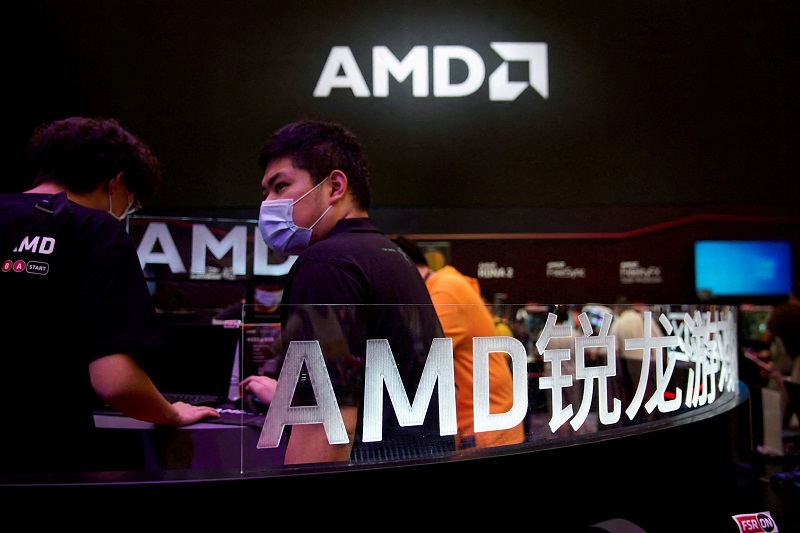
Investing.com -- Shares of Advanced Micro Devices fell 4.3% in pre-open trading after the U.S. Commerce Department’s Bureau of Industry and Security published new guidance late Sunday closing a loophole that had previously permitted AMD’s MI350x AI accelerators to be shipped to Chinese-controlled subsidiaries operating outside mainland China without the same licensing requirements applied to direct exports into China. Investors are digesting fresh export-control guidance that targets high-end AI accelerators sold to Chinese-owned entities via third countries and raises questions about demand for AMD’s MI350 products. AMD is also reported to be seeking clarity from the U.S. Commerce Department on how the updated regulations will be interpreted for existing customer agreements and pipeline opportunities in Asia outside mainland China.
Adding to the pressure, the new clarification closes loopholes that previously allowed shipments of top-tier AI processors, including AMD’s MI350x accelerator and Nvidia’s Rubin and Blackwell families, to Chinese-controlled subsidiaries outside mainland China without the same license scrutiny as direct exports to China. On the competitive front, Nvidia announced its RTX Spark chip line at Taiwan’s Computex conference, featuring the N1X processor developed with Microsoft and designed by MediaTek, targeting premium Windows laptops and desktops — a direct challenge to AMD’s client CPU franchise. Meanwhile, Barclays maintained AMD at Overweight and raised its price target to $665 from $500, while Mizuho maintained its Outperform rating and lifted its target to $615 from $515, providing some fundamental support but failing to offset the regulatory-driven selling.
From a broader market perspective, U.S. equity indices are modestly positive in early trading — the S&P 500 is up 0.2%, the Dow Jones is up 0.7%, and the Nasdaq is up 0.2% — meaning AMD’s decline is a sharp underperformance relative to the tape and is driven by company- and sector-specific factors rather than a general risk-off environment. Market commentary suggests the export steps are enforcement clarifications rather than a sweeping new ban, but they still raise the compliance burden for AMD and its distribution partners and may introduce uncertainty around future sales to customers whose ultimate parent company is based in China.
Taken together, the combination of a sudden regulatory tightening that clouds AMD’s fastest-growing AI data center segment, intensifying competitive dynamics from Nvidia’s PC market entry, and the stock’s proximity to its 52-week high of $527.20 after a massive run-up have collectively triggered pre-market profit-taking. The stock had already surged following AMD’s first-quarter earnings report, when revenue growth accelerated and management’s guidance for the current period was impressive, leaving shares vulnerable to any incremental negative catalyst — which today’s export-control news has provided.
This article was generated with the support of AI and reviewed by an editor. For more information see our T&C.
Most traders can read a chart. The hard part is the moment: entry window open, pattern forming, and you're still waiting for more confirmation. That's the conviction gap — and our chart analysis closes it. Unlike other AIs that just read data, our Vision AI literally "sees" your charts and hands you a complete trading plan: entry, stop-loss, and profit target in under 60 seconds. Know exactly what to do next, every time.