
Key insights
- The Supreme Court is reviewing Trump's executive order to end birthright citizenship, challenging the 14th Amendment's interpretation. A ruling redefining citizenship could create administrative and economic ripple effects, impacting healthcare, labor force projections, and potentially increasing social instability. The court's decision could negatively impact market sentiment due to increased uncertainty.
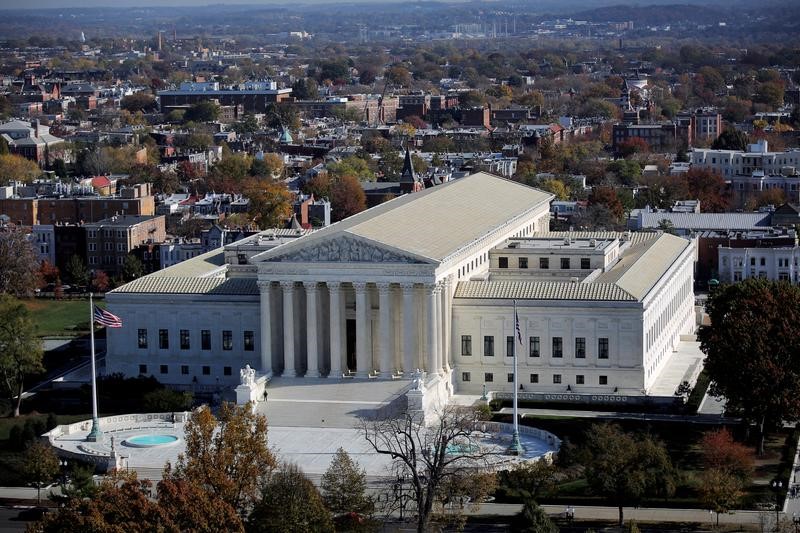
Investing.com -- The legal battle over the foundational definition of American citizenship reaches a climax this Wednesday as the Supreme Court prepares to hear arguments on President Trump’s executive order to end birthright citizenship.
The case represents one of the most significant constitutional challenges of the 2026 term, testing the administration’s attempt to deny citizenship to children born on U.S. soil to undocumented immigrants or temporary visitors.
At least six lower courts have already ruled the policy unconstitutional, and the proceedings are set against a backdrop of unprecedented public friction between the White House and the judiciary.
At the heart of the dispute is the 14th Amendment’s Citizenship Clause, which states that "all persons born or naturalized in the United States, and subject to the jurisdiction thereof, are citizens." For over a century, since the landmark 1898 Wong Kim Ark decision, this has been interpreted as a near-universal guarantee.
The Trump administration, represented by Solicitor General D. John Sauer, is now asking the Court to adopt a narrower "jurisdictional" theory that would exclude children of those without permanent legal status.
The "revisionist" approach has met fierce resistance from a broad spectrum of legal scholars, who argue the move defies both the plain text of the Constitution and established history.
The market and policy implications of a potential ruling are substantial. A shift in citizenship status would create immediate administrative and economic ripple effects, impacting everything from healthcare eligibility to future labor force projections.
During preliminary hearings, even conservative justices like Brett Kavanaugh raised practical concerns regarding the "real-world" execution of such a policy, questioning how hospitals and state agencies would manage newborns under a tiered citizenship framework.
The timing of the case is particularly sensitive following the Court’s recent rejection of the administration’s global tariff program. President Trump has recently escalated his rhetoric against the bench, publicly questioning the "patriotism" of justices who rule against his agenda.
Legal analysts suggest the President may view the case as a "win-win" political tool. Either a landmark victory for his immigration platform or a high-profile defeat that allows him to frame the conservative-led court as an obstacle to his domestic security goals.