
Key insights
- Micron is constructing one of the largest semiconductor factories in US history in Syracuse, New York. This significant investment is expected to revitalize the city, which has experienced substantial job losses due to de-industrialization. The project is seen as a potential model for reindustrialization across other struggling Rust Belt cities, with Syracuse currently leading New York State in job growth.
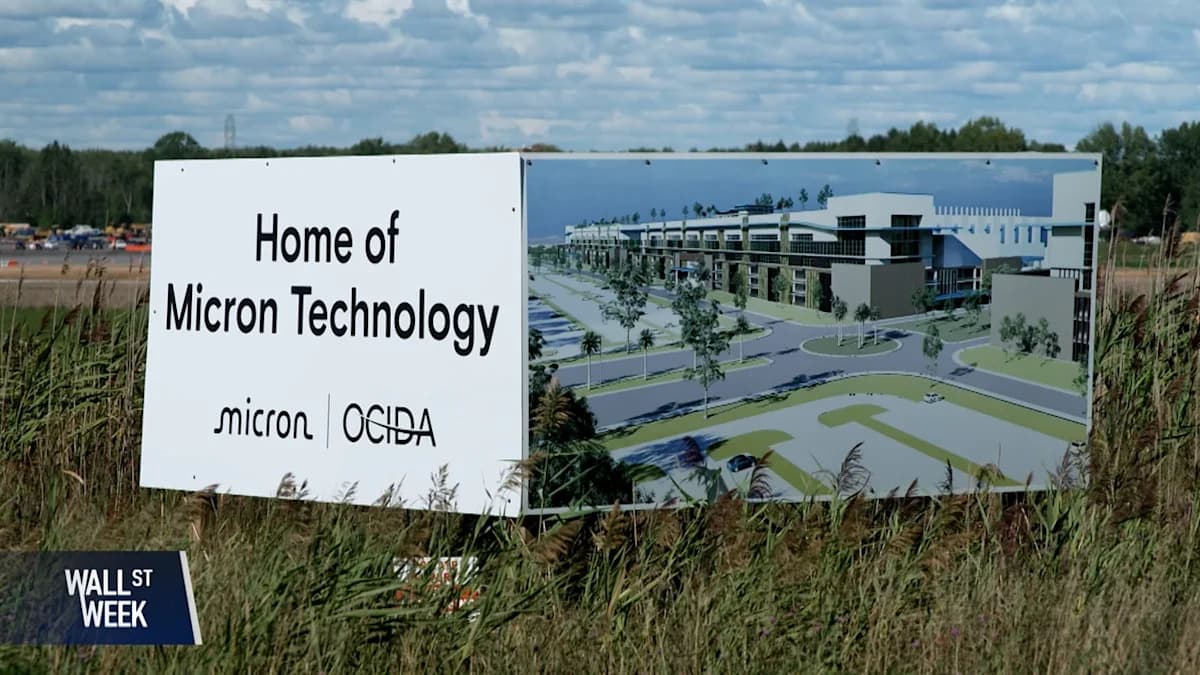
What does it actually take to bring a Rust Belt city back to life? Micron is building one of the largest semiconductor factories in US history in Syracuse, a city that experienced major job loss after companies including GE, Carrier and General Motors left the area. Rob Simpson of CenterState CEO explains what attracted Micron to the city, local business owner Darin Price talks about what the investment means on the ground, and Brookings economist Joseph Parilla makes the case that Syracuse could be a model for reindustrialization across America.
This is a story about comebacks. About 250 miles northwest of the hustle and bustle of New York City lies Syracuse, New York. It's home to a major university named for the city, and once also counted major manufacturing companies like Carrier and General Electric among its residents. But in recent times, while the university has remained, many of the manufacturers have moved on, along with their jobs.
The entire Upstate New York corridor is a part of the country that I think was uh really hit hard by uh de-industrialization and globalization. Starting in the late 70s, uh all the way through the early 2000s, uh our communities fell on uh really challenging times. Uh jobs left, people then followed.
This problem of de-industrialization is not unique to Syracuse. Across the country, from Flint, Michigan to Youngstown, Ohio, once thriving industrial cities have grappled with the same forces shaping American manufacturing.
Syracuse native Rob Simpson saw that decline firsthand. Today, he leads CenterState CEO, the region's main business and economic development organization, and he has spent much of the past two decades trying to change his city's trajectory.
You say you've made some real progress. Give us a snapshot right now of where the economy is in terms of employment, in terms of growth.
Syracuse and Central New York are leading the state of New York in job growth. Uh we have a rate of uh job growth that is higher even than New York City. It's the first time in 30 years that that has happened. Uh we're seeing economic performance across the board in every industry from uh leisure and hospitality all the way up through advanced manufacturing and high-tech. and obviously, the thing that everybody is talking about here in Syracuse right now is the once in a generation investment by Micron in our community, bringing 9,000 direct jobs, 40,000 indirect jobs over the next 15 to 20 years, and more than 100 billion dollars in capital investment right here in our backyard.
For those who say, New York is a place that's too hard to do business. Then what are we doing here? Micron could have gone anywhere in the country.
With a market cap of over a trillion dollars, Micron is one of the world's largest semiconductor companies. And construction is now underway on its massive new manufacturing campus outside Syracuse, a project local leaders hope will anchor a much larger semiconductor industry in the region.
What made Syracuse the right place for Micron?
I think it was a combination of factors. Uh first, we had a great piece of real estate. Uh our county has been working to build a business park, the White Pine business park which Micron selected as their future home for their mega fab campus. We have a tremendous power asset, all of the hydropower coming from Buffalo and the nuclear power coming from Oswego in Lake Ontario to the north. All of those literally intersect right across the street from the site that Micron selected.
What about a skilled workforce?
One of the things that we shared with Micron early in the recruitment and I think that was uh one of the big barriers. We had to get them over the hump to understand that we could generate the workforce here. We happen to have 17 colleges and universities that offer degree-bearing programs within two hours of where I'm sitting right now in in downtown Syracuse. Those 17 schools collectively, they graduate 7250 engineers that are directly related to the needs of not only Micron, but Micron's supply chain partners.
And the benefits of landing a company like Micron can extend far beyond the company itself. Darren Price started Right Price companies in Syracuse more than 20 years ago.
At that point in time, we sold office supplies, we sold commercial furniture, we sold promotional products and Jan San. But we quickly realized after the first year that we had to specialize in something and commercial furniture gave us the most margins. So we really dove into the commercial furniture industry. Around 14 years ago, we started the RPC technology brand where we were selling um fiber optic cable, computer supplies, electrical supplies.
But Micron represents a new kind of opportunity.
Winning Micron business for us would mean a lot. It would mean a lot not only for right price companies, but it would be mean a lot for our community, for the Syracuse community. Uh Micron is so large, we're looking to be a creator of jobs here. So being awarded jobs with Micron, we'd be able to hire local. We'd be able to grow local and really impact the footprint of Syracuse.
Price is optimistic, but also cautious. As someone who's watched major employers come and go before, he hopes Micron is here to stay.
I think when Micron first announced, there was definitely some hesitation uh because people experienced the rust belt. People experienced the major employers that we had pack up and leave. And, you know, a guy like me, you know, growing up during that, you know, my father worked at Carrier and, you know, my friends, their parents worked at General Motors and at Chrysler. Um they worked at GE, they worked at Bristol and uh allied, they worked a number of different places. When we got when our time came up, those jobs were gone. And, you know, most people, a lot of people left for employment. Now the great thing about it is, we're seeing the opportunity for now our kids not to leave for they can stay right here and have very good careers.
Joseph Parilla, an economist at the Brookings Institution, studies why investments like Micron's transform some local economies and what determines how widely those benefits spread.
At the end of the day, I, you know, every place has to have a set of economic activities, you know, we call these industries and companies, uh that create something, a product or a service, you know, within that place and export it to the rest of the country and the rest of the world. And they bring back income and that income creates jobs and growth.
Um if you don't participate in what we call the export economy, what I just described, um it's very hard to have shared prosperity because that is where quality jobs are created and it's where uh the spillovers happened to what we call the locally serving part of the economy. So that's like retail, healthcare, uh things that we all spend with our income.
And so, you have to find some new growth engine within those industries and in the United States, that tends to be in advanced industries, the most innovative, uh require sort of technical talent. And those advanced industries, you know, they're highly competitive, but if you can get a foothold in one, uh you reap the benefits for your workforce because jobs in those advanced industries are 50% more likely to be quality uh family sustaining wage jobs than those in the locally serving part of the economy. So you sort of have to find some new source of exports and uh mechanism to bring wealth back in. And you know, you can't run away from that as much as we we may want to say, oh, there's a different way to grow. It's very hard for any individual place to grow without some connection to the global economy.
We've seen uh quite a few cities with a new plan of some sort or the other, several times, more than one time, new plan. Which ones work and which ones don't?
And I think there is a recipe of sorts uh for economic revitalization. So first, you know, you have to have a shared strategy. Uh you have to have an understanding of your economic starting point. And then, you know, government, the private sector, civil society have to come behind and understand what that strategy should be. Second, you need to invest in the things that determine a place's long run competitiveness and prosperity. So that's, you know, your workforce being the most important thing.
uh infrastructure, um some sort of source of innovation in an era of technological change, whether that's a university or a startup ecosystem. And then the sort of secret sauce is how can we marshal those investments, say in a training program or, you know, an entrepreneurship strategy uh together in alignment across the public sector, private sector and civic and philanthropic sectors. Uh that alignment is really often what determines whether a strategy will work or not in its delivery phase.
With the help of Micron, Syracuse appears poised for a comeback and the potential for thousands of new skilled and well-paid jobs could turbo charge that comeback. But having a major anchor can both help jump start a regional economy and also pose the risk of making that economy vulnerable to corporations deciding to move in a different direction down the road. That's something Rob Simpson says Centerstate is already planning for.
You know, there's downside risk as well in having one big employer come in and make a difference in an economy. What can you do to try to diversify against that possibility down the road?
I I'm really glad you asked that question because this is something that we uh we talk about and we think about every day. every public appearance I give, I talk about how important it is that we not make the mistake of falling into a company town. My grandfather back in the 1950s worked at, uh worked at GE when they had 22,000 people out in Liverpool, New York, five five miles from where we sit. We were a company town. We lost our ability to innovate. We stopped s